The traveling exhibition Southern/Modern, opening at the Frist Art Museum on January 26, includes a stimulating line up of 100 paintings and works on paper created in the American South from 1913 to 1955. The museum notes that this is the first comprehensive survey of its kind and includes thematic groupings, weaving together the “region’s rich cultures, telling stories of agriculture and industry, class division and racial injustice, natural beauty and stylistic innovation.”
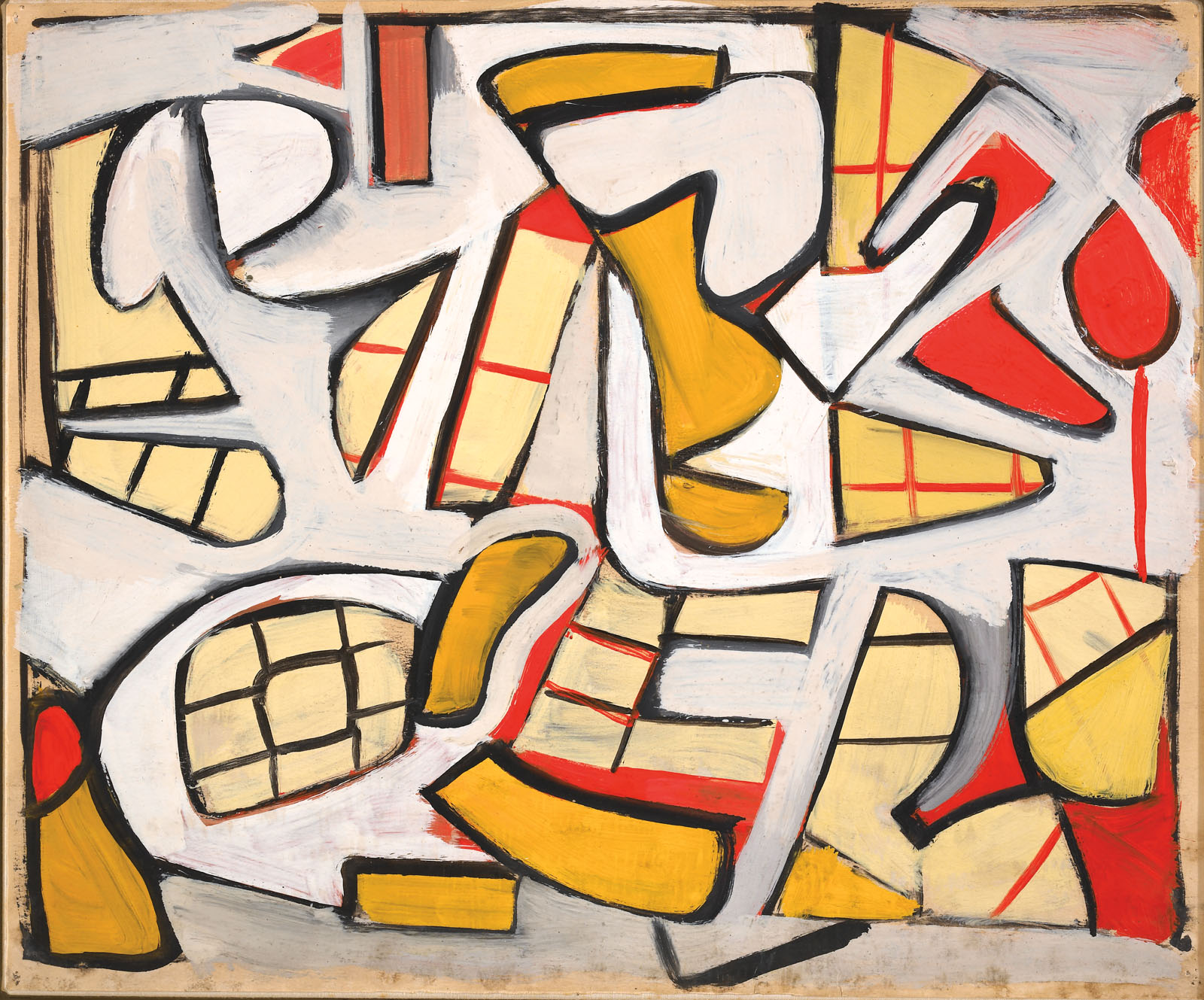 Elaine de Kooning (1918-1989), Black Mountain #6, 1948. Enamel on paper mounted on canvas; 26 x 32 in. The Heckscher Museum of Art, Huntington, NY. Museum purchase, 1991.20.
“The exhibition explores the history of socially and stylistically progressive art in the American South,” continues Mark Scala, chief curator at the Frist. “Treating a subject long neglected by art historians and museums outside the region, Southern/Modern shows how in the South, as elsewhere, the goal of modernism was to lead the way toward a more equitable society that embraced change.”
Scala notes that to explore this idea, the exhibition curators Dr. Jonathan Stuhlman, senior curator of American art at the Mint Museum; and Dr. Martha R. Severens, an independent scholar, included important works by women and people of color, with styles ranging from American scene painting and regionalism to cubism and abstraction.
In addition, works are included by artists who created outside of the South, like Josef Albers and Elaine de Kooning, but reflected on “Southern experiences from a distance,” reads the exhibition press release. Featured is the abstract expressionist Black Mountain #6, 1948, by de Kooning (1918-1989).
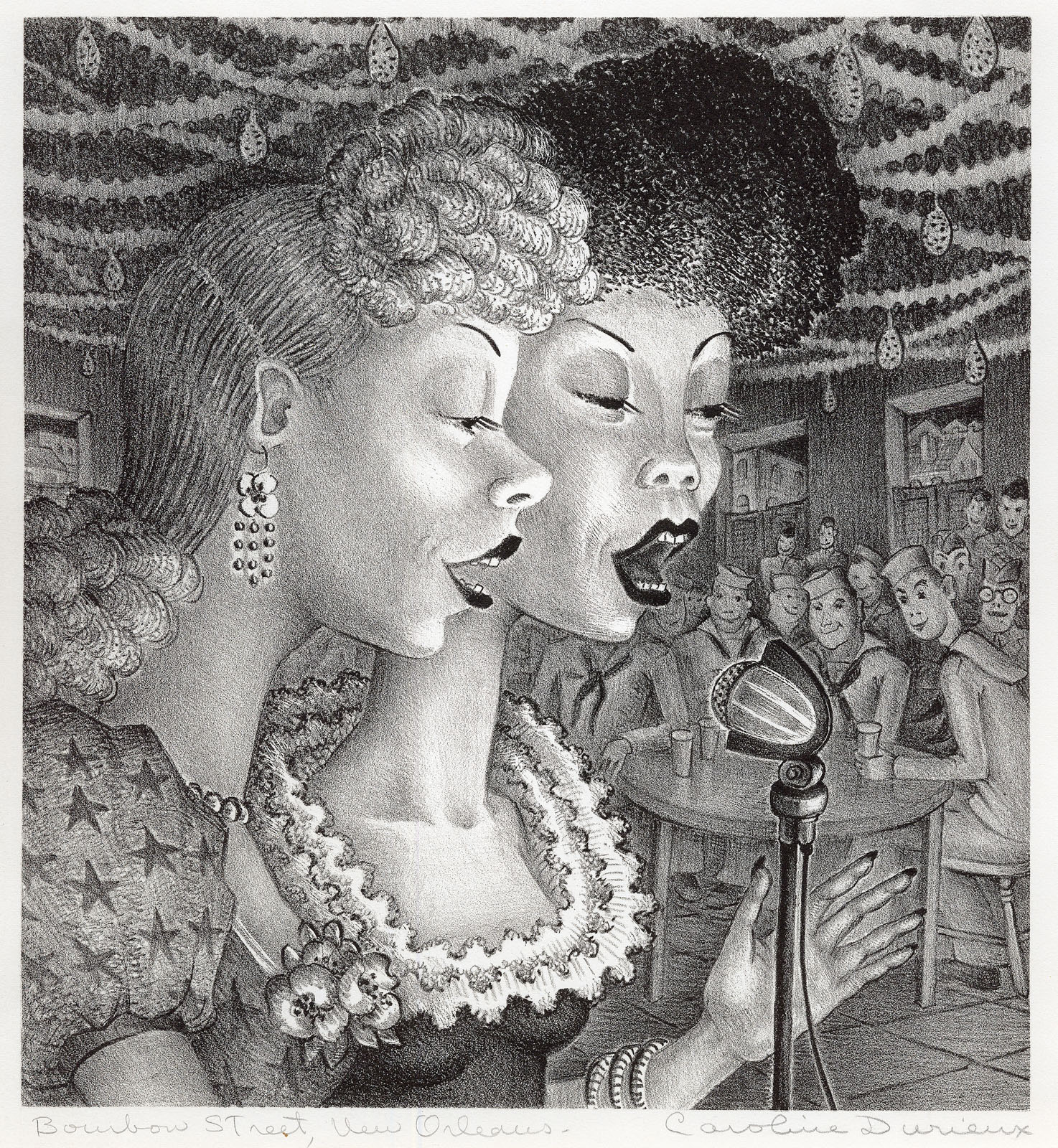 Caroline Durieux (1896-1989), Bourbon Street, New Orleans, 1934. Black lithograph on paper; 10½ x 10½ in. Louisiana State Univeristy Museum of Art, Baton Rouge, LA. Gift of the artist, 63.9.18.
In the exhibition’s themed section titled “Southerners,” we find works like Bourbon Street, New Orleans, 1934, by Caroline Durieux (1896-1989). The themed groupings “start with images of southerners at leisure, living their lives as people do everywhere,” Scala shares. “The idea is to challenge the frequently held stereotypes of Southerners as being intrinsically different.”
Bourbon Street shows two female singers of African descent performing in a club for what appears to be white sailors on shore leave. “The work illustrates that, while much of the South was not integrated, in New Orleans there has always been significant racial interaction,” Scala says.
Placed in a section devoted to images of labor, we see Where the Shrimp Pickers Live, 1940. “Dusti Bongé (1903-1993) is an important but overlooked modernist who, while being active as an artist and arts advocate in Mississippi, had been an actress and exhibiting artist in New York,” Scala explains. “She took various jobs to make a living in Mississippi, among them collecting rent from shrimp pickers. Her depiction of their quarters is subtly abstracted and geometrical, but it gives a sense of their impoverished living conditions.
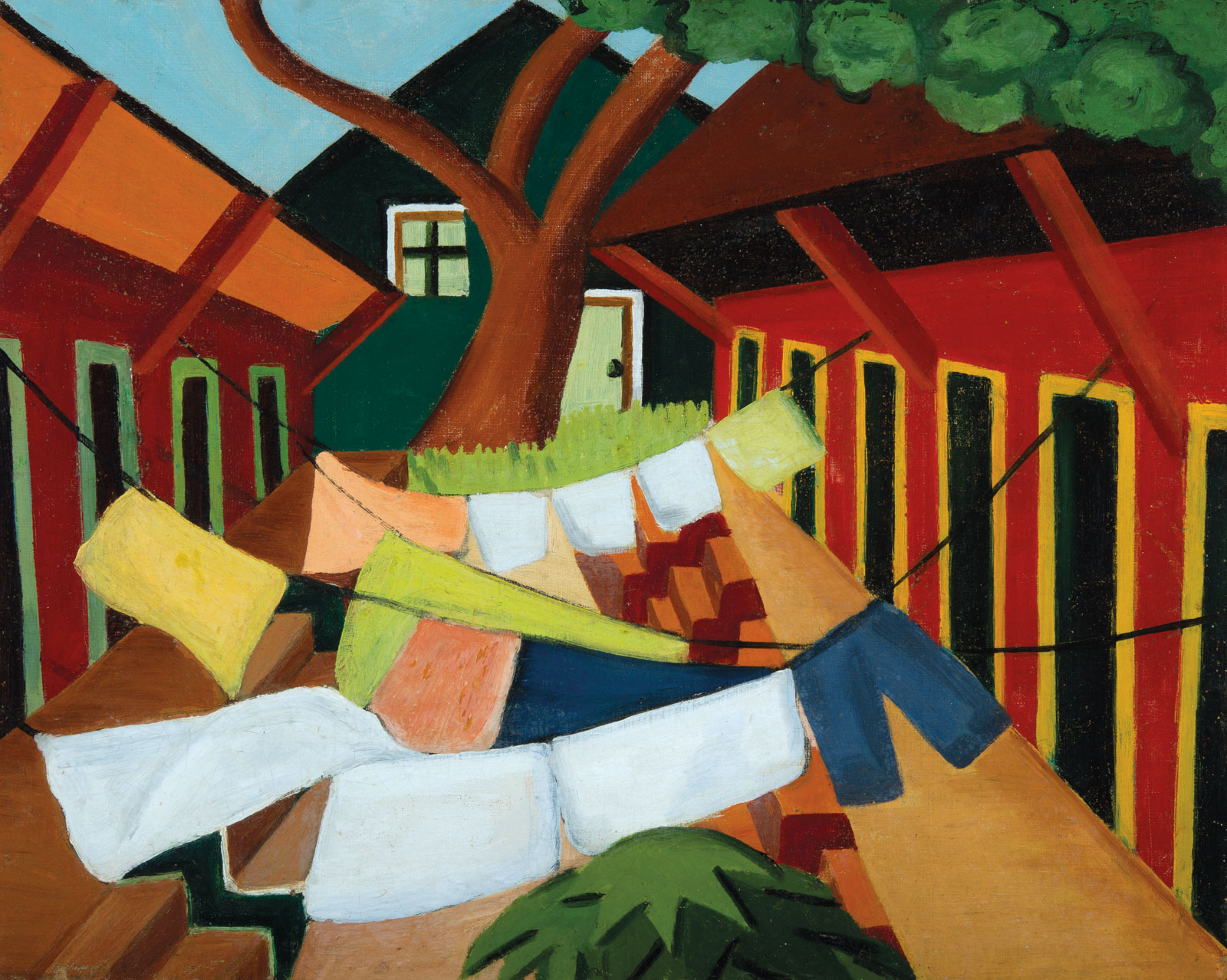 Dusti Bongé (1903-1993), Where the Shrimp Pickers Live, 1940. Oil on canvas; 16 x 20 in. Mississippi Museum of Art, Jackson, MS. Gift of Dusti Bongé Art Foundation, Inc., 1999.012. © Dusti Bongé Art Foundation.
Overall, Scala hopes the exhibition audience will see a premonition of the South that was to come and is today.
The exhibition will be on view through April 28, when it will then travel to the Dixon Gallery and Gardens in Memphis, Tennessee.
Powered by Froala Editor